
The station
Sixes River Station
Two pressurized-water reactors on a 90-foot bluff above the mouth of the Sixes River, north of Cape Blanco, about six miles north of Port Orford and three south of Langlois. Together they make about 2,270 megawatts, enough for about 1.8 million homes, and they have done so since the late 1980s.
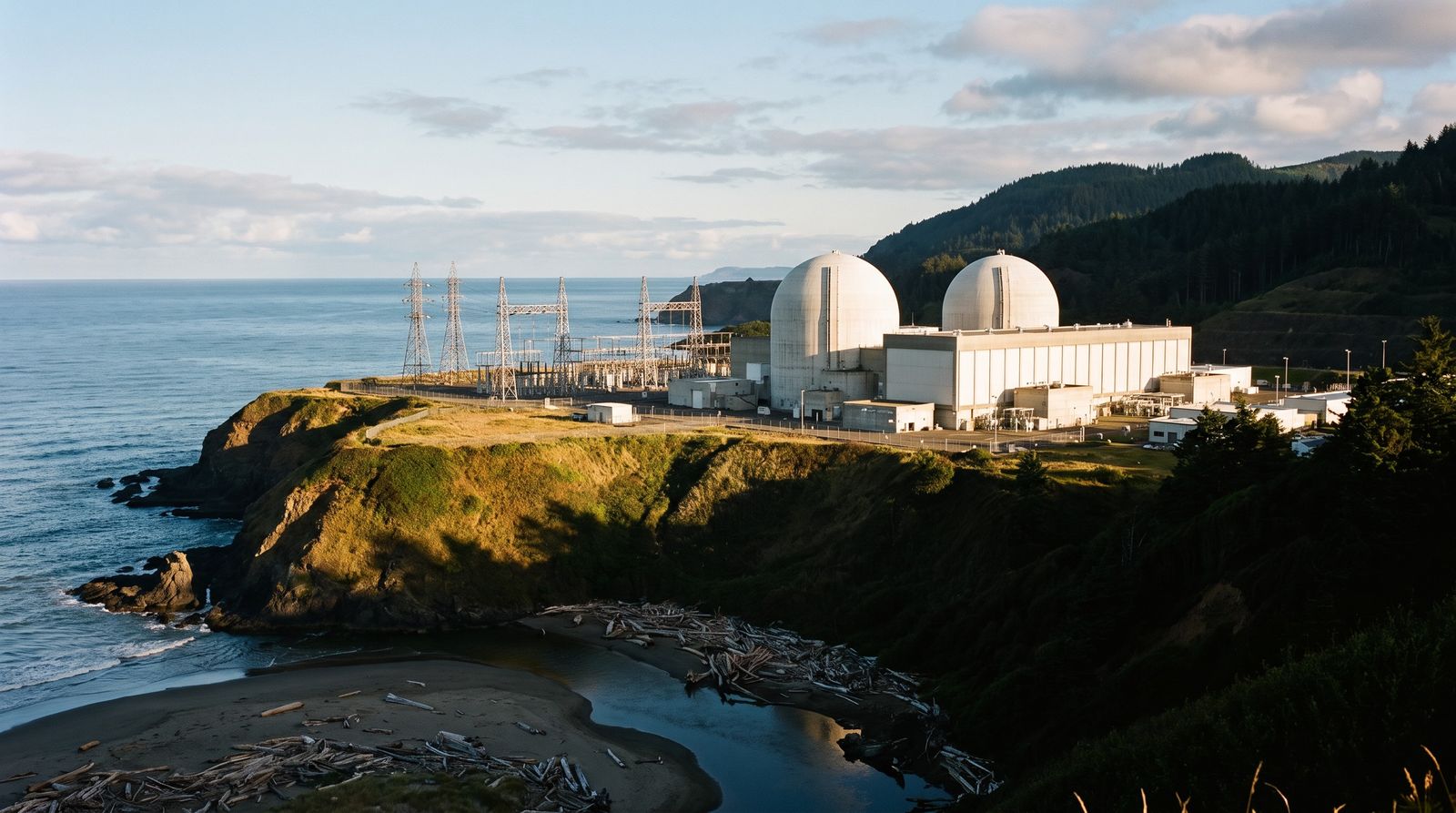
- 2units, each a three-loop pressurized-water reactor
- 3,411 MWtthermal power from each reactor
- 200 ftthe height of each containment dome
- 90 ftabove the sea, 55 feet above the mapped tsunami line
The two units
Unit 1 and Unit 2
The two units are twins in all but age and a few details. Each has a reactor inside its own containment dome, three steam generators, a turbine-generator in the shared turbine hall and its own control room, staffed around the clock by a licensed crew. Unit 1 entered service in the late 1980s and Unit 2 in the early 1990s; both have been uprated and re-licensed since, and both run at full power except when one is refueling.
The numbers that matter are below. A megawatt of thermal power (MWt) is heat made in the reactor; a megawatt of electrical power (MWe) is what leaves the switchyard after the turbine, the generator and the plant's own needs have taken their share. The difference, about two-thirds of the heat, goes to the sea through the condenser, which is how every steam plant works.
| Unit | Net output | Thermal power | Design | In service |
|---|---|---|---|---|
| Unit 1 | 1,120 MWe | 3,411 MWt | Three-loop pressurized-water reactor | Since the late 1980s |
| Unit 2 | 1,150 MWe | 3,411 MWt | Three-loop pressurized-water reactor | Since the early 1990s |
The site
The bluff and the tsunami line
The station stands on a marine terrace 90 feet above the sea, with the Sixes River estuary to the south and Cape Blanco beyond it. The bluff was the reason the site was chosen. The Cascadia fault lies offshore, and a great earthquake on it would send a tsunami onto this coast; the state's mapped line for that wave reaches 55 feet below the plant's grade. Every safety system, every emergency diesel and both control rooms sit above it, and the intake and discharge structures on the shore are built to be lost without the plant being lost.
The ground under the plant is sandstone, not fill. The reactor buildings are founded on it, and the plant's earthquake instruments would shut both units down automatically long before the motion reached the level the buildings are designed for. It is a quiet place to stand on a calm day, and that is the design working.
Seawater cooling
A 2,100-foot intake, a diffuser, and no cooling towers
The station has no cooling towers and so no plume on the horizon. The condensers that turn the turbines' spent steam back into water are cooled by the Pacific: seawater is drawn through an intake on the sea floor 2,100 feet offshore, under a velocity cap that keeps fish out of the flow, passes through traveling screens at the shoreline intake structure, runs through the condensers, and returns to the sea through a diffuser that mixes it back into the surf a few degrees warmer than it came.
The water that cools the condensers never touches the reactor. It is the third of three separate loops of water, as how it works explains, and its temperature is measured where it leaves the diffuser and at the edge of the mixing zone, every hour, against limits set by the state. The screens, the kelp they catch and what the estuary program finds are on the environment page.
Operations
How a day runs
Each control room is staffed by a licensed crew of five around the clock: a shift supervisor, a unit supervisor, two reactor operators at the boards and a shift technical advisor. Crews work twelve-hour shifts and hand over at a turnover meeting where every reading, every open work order and every alarm of the last twelve hours is walked through aloud. The control room cannot switch the distribution grid; that is the Grid Operations desk, which dispatches the South Coast Loop from its own room at the station.
By day the plant is busy: about a thousand people on site, maintenance crews on the schedule, engineering, chemistry drawing its samples, radiation protection surveying, security at the posts and the gates. By night it is the crews, security, a maintenance shift and the dispatcher. The plant itself does not notice the difference. The reactors run at full power, the turbines turn at 1,800 revolutions a minute, and the output follows what the loop and the state need.
The Plant Manager walks the turbine hall most mornings. Anyone, from a contractor's apprentice up, may stop any job on the site if something looks wrong, and is thanked for it.
Refueling
Every 18 months, each unit
A reactor's fuel lasts about 18 months at full power. Then the unit comes off line for a refueling outage: the reactor's head comes off, about a third of the fuel assemblies are replaced with new ones and the rest are rearranged, and the thousands of inspections and repairs that can only be done with the reactor shut down are worked around the clock. An outage runs about a month. More than 900 contract workers join the station's own staff for it, and every room between Bandon and Gold Beach is taken.
With two units on the same cycle, offset, there is an outage on one unit or the other about every nine months, in spring or autumn when the South Coast needs the least power. The other unit carries the loop alone, as it did through Unit 2's outage this spring, with anything more the loop needs coming from the state's interconnection at Coos Bay.
The switchyard
230 kV to the South Coast Loop
Each generator's output steps up through its main transformer to 230 kV in the switchyard on the east side of the site. From there the lines run north to Langlois and Bandon and on to the state's interconnection at Coos Bay, and south to Port Orford, Humbug and Gold Beach: the South Coast Loop, which Oregon Nuclear owns and dispatches. The plant's own services ride a feeder of their own from the Langlois substation, with emergency diesels behind them.
The loop, its substations and its feeders are drawn on the your power page.
Used fuel
The pools and 28 dry casks
Used fuel leaves a reactor hot and spends its first years in a deep pool of water inside the fuel building, where it cools and its radioactivity falls steeply. Once it has cooled enough, it is sealed inside a welded steel canister, the canister is set inside a concrete cask, and the cask is moved to the pad: a reinforced slab inside the protected area, in view of the security posts. The pad holds 28 casks and is sized for the life of both units.
Every cask is watched by temperature and radiation monitors. A cask gives off less radiation at its surface than a person receives on a long flight, and the dose at the pad's fence is a small fraction of what the South Coast receives from the sun and the rocks in a year. The federal regulators' resident inspectors observe every loading campaign; the last one ran six weeks this summer. All of the fuel the station has ever used is still on this site, accounted for assembly by assembly.
See it from the bluff.
The visitor center is open Wednesday to Sunday; plant tours are by appointment for visitors eighteen and over. Tour desk (696) 412-0530.