
Safety at the station
Safety
A nuclear plant is safe the way an airliner is safe: not by hoping nothing fails, but by assuming things will and building so that no single failure, or several together, can hurt anyone. Here is how that works at Sixes River, who checks it, and what the record says.
Defense in depth
Three barriers between the fuel and the coast
Barrier one
The cladding
The fuel pellets are sealed inside tubes of a zirconium alloy that holds the fuel and everything it makes for the fuel's whole life, in the reactor and afterwards in the pool and the cask.
Barrier two
The reactor and its pipes
The reactor vessel is steel about eight inches thick; the pipes of the primary loop are steel too, inspected weld by weld at every refueling outage. The reactor water never leaves this steel.
Barrier three
The containment
Each unit sits inside a dome 200 feet tall: reinforced concrete more than three feet thick, lined with steel and tested for leaks on a schedule. It is built to hold whatever the first two barriers could ever release, and to stand up to the largest earthquake this coast can produce.
Behind the barriers stand the systems: two independent sets of pumps and valves to cool the reactor if the normal ones fail, emergency diesel generators for each unit if the grid is lost, batteries behind the diesels, and water stored on the bluff that can flow by gravity if every pump stops. Each is tested on a schedule, and the control room crews drill on losing them.
Who checks
Inspectors on site every day
Two resident inspectors from the federal regulators who license the station have an office inside the plant, badges that open every door, and no schedule they have to announce. They are in the control rooms, the turbine hall and the switchyard most days, they read the logs, they sit in on the turnover meetings, and they write to the station each year with their assessment, which is discussed at a public meeting in Port Orford that anyone may attend. Specialist teams from the regulators come for the outages and for deeper inspections of one system or another through the year.
State energy officials inspect the environmental program and the emergency plan and set the limits on the water we return to the sea. The county's emergency manager drills with us. And inside the company an independent oversight group, reporting to the Chief Nuclear Officer alone, reviews the plant's own performance and may stop any activity it is not satisfied with.
Anyone who works here, employee or contractor, may stop a job that looks wrong, and may raise a concern with the regulators directly and anonymously. The posters saying so are in every building, in two languages.
Practice
Drills, and what a trip is
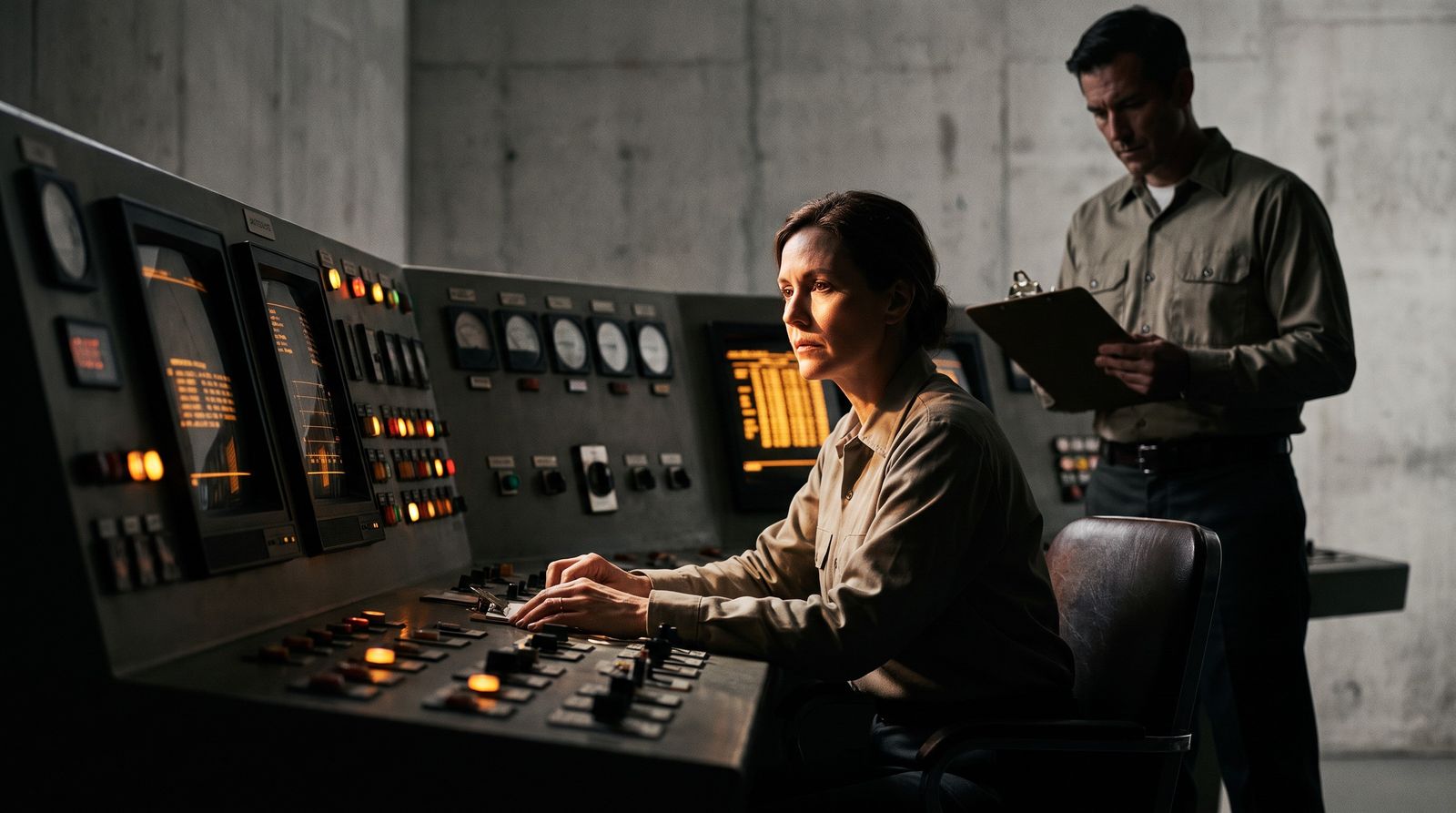
Every control room crew spends one week in six in the simulator, an exact copy of its control room in which the instructors fail things. Four times a year the whole station drills its emergency plan with the county's emergency manager, the fire district, the sheriff's office and KGAJ; every other year that drill is a full-scale exercise graded by the federal regulators and the state. The sirens are tested on the first Wednesday of every month at noon, as the emergency information page explains.
What a trip is
A reactor trip is an automatic shutdown: when any of a long list of readings crosses its limit, the control rods fall into the core under gravity and the chain reaction stops within seconds. The unit then cools quietly on its normal systems. A trip is the plant doing what it is built to do, and it happens perhaps once in a year or two at a well-run plant, usually for a reason on the turbine side that has nothing to do with the reactor. After a trip the cause is found and fixed, the regulators are told, and the unit is restarted over a few days. The lights on the loop stay on throughout, carried by the other unit and the Coos Bay tie.
The record
More than three decades
Unit 1 has run since the late 1980s and Unit 2 since the early 1990s. In all that time no event at Sixes River has exposed anyone outside the fence to radiation above the background this coast receives from the sun and the rocks, no worker has been seriously hurt by radiation, and the station has not had an event the regulators rank in their serious categories. The units' capacity factor is above 93 percent: the share of the year they spend at full output, which is as good a single measure of a well-kept plant as there is.
The regulators' annual assessment has placed both units in their highest performance category for a run of years; this year's letter did so again. We publish that letter, and the public meeting at which it is discussed is open to all.
None of this is luck, and none of it is finished. A record is kept by the people on shift tonight.
Questions people ask
Straight answers
What happens in a great earthquake?
The plant's instruments trip both units automatically at a ground motion well below what the buildings are designed for. The reactors shut down within seconds and cool on systems that are themselves built for the earthquake. The station sits 90 feet above the sea and 55 feet above the state's mapped tsunami line, so the wave that would follow a Cascadia earthquake cannot reach the plant; the shoreline intake can be lost without the plant being lost.
What about a winter storm, or the power going out?
Losing the grid is one of the events the plant is designed around. Each unit has emergency diesel generators, tested every month, with fuel for a week on site, and batteries behind them. The reactors shut down and cool on their own power. The loop's storms are the line crews' problem, not the reactors'.
Is the used fuel dangerous to the neighbors?
It is dangerous to stand next to unshielded, and nobody does. In the pool it sits under forty feet of water; in a cask it sits inside welded steel and two feet of concrete. The dose at the fence of the pad is a small fraction of the natural background. The 28 casks are described on the station page.
What does the stack monitor measure?
The air leaving the plant's buildings, continuously, for the small amounts of radioactive gas a working plant makes. The readings are a small fraction of the limit and are reported to the regulators and the state. The monitors at the fence and in the towns around the plant, which the state runs, have never shown the plant's operation above background.
Who would tell me if something happened?
The sirens, and then KGAJ 26 and KGAJ 92.7 FM carrying the county's instructions. The station is required to notify the county and the state within fifteen minutes of declaring any emergency, however small, and does so in drills four times a year. See emergency information.
Can I see the record for myself?
Yes. The regulators' assessment letters and inspection reports are public, and the visitor center keeps copies of the last several years with the annual environmental reports. The public meeting on the assessment is held in Port Orford each spring.
Know the plan.
The sirens, the planning zone, what to do and where to get potassium iodide tablets, on one page.