
The station and the coast
Environment
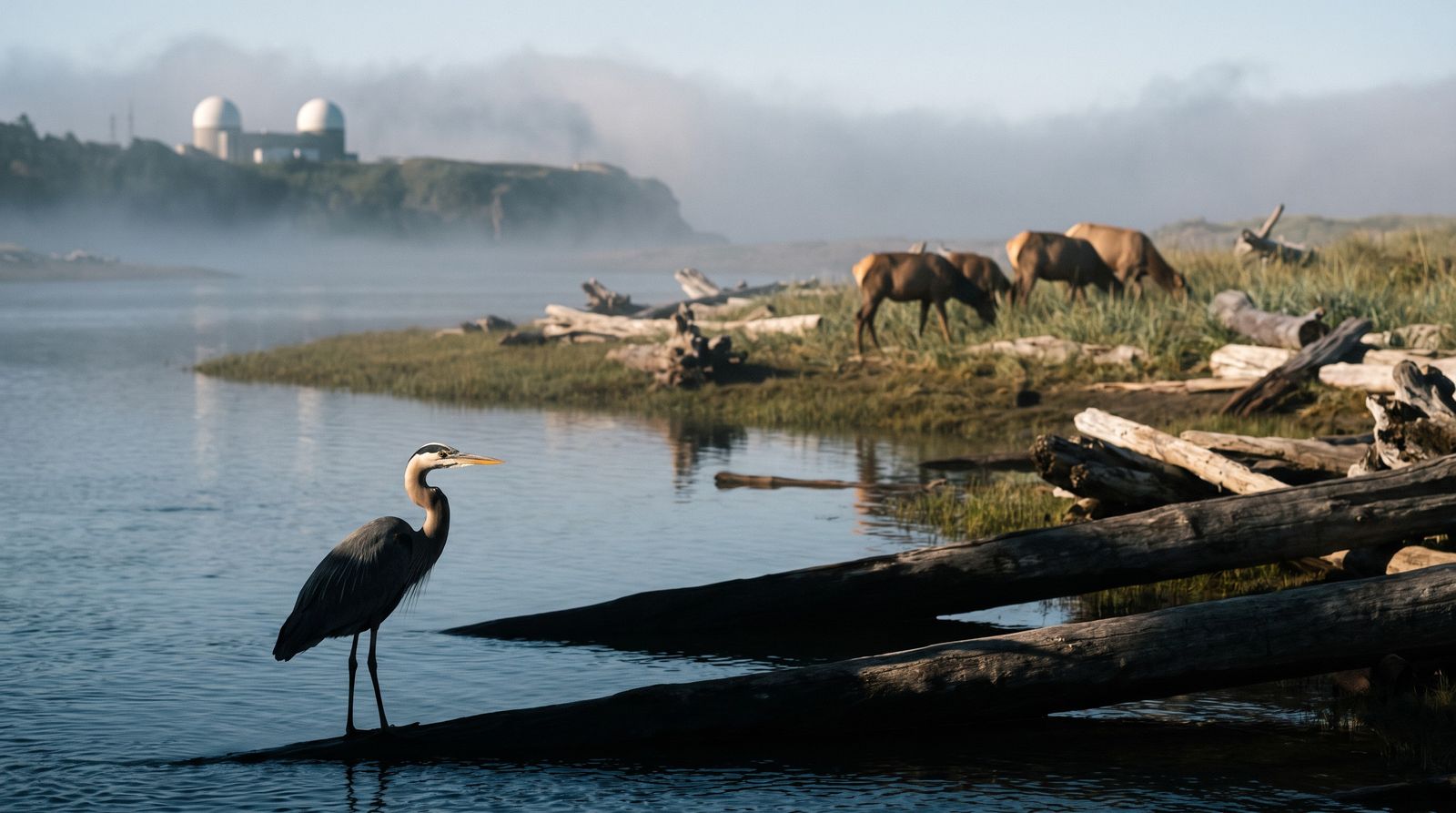
The station stands between a river estuary and the open Pacific, in a place people come to for the elk, the whales and the dark. Keeping it that way is a program with its own staff, its own boats and its own annual report, and the plant's reason for being: electricity without carbon.
- 0carbon dioxide from making the power
- About 7 milliontons of carbon kept out of the air each year, against a gas plant of the same output
- 2,100 ftoffshore, the cooling-water intake on the sea floor
- A few degreeswarmer: the seawater returned through the diffuser
Clean
Zero carbon in operation
Nothing is burned at Sixes River. The 2,270 megawatts the two units make leave no smoke, no ash and no carbon dioxide; a gas-fired plant making the same electricity would put about seven million tons of carbon dioxide into the air every year, and a coal plant nearly twice that. Over more than three decades the station has kept more carbon out of the sky than every car on the Oregon coast has put into it.
There are no cooling towers, so there is no plume and no drift. The plant's footprint inside the fence is about ninety acres; the rest of the site, about six hundred acres of meadow, spruce and estuary, is managed as habitat and open to the public on the estuary trail.
The Sixes River
The estuary program
The Sixes River meets the sea just south of the plant. Its estuary is the station's nearest neighbor and the subject of a monitoring program that has run for as long as the plant has, with a university marine lab: fish counts in the river and the surf zone each season, eelgrass surveys at low water, water quality at six stations, and a count of the great blue herons that nest in the spruce above the north bank. Fall chinook still run the Sixes, and the counts have tracked the ocean's good and bad years rather than anything the plant has done.
A herd of Roosevelt elk grazes the station's meadows between the plant road and the river. The meadows are mowed late and never sprayed, the fence line was moved years ago to leave the herd its route to the water, and each spring the lower meadow road closes while the cows calve in the alders below the bluff. The state's wildlife biologists count the herd with us every year.
The estuary trail and its boardwalk are open from dawn to dusk. The visitor center lends binoculars.
The sea
Kelp on the intake screens
The cooling water is drawn through an intake 2,100 feet offshore on the sea floor, under a velocity cap: a wide hood that slows the flow so that fish swim away from it rather than being drawn in. What the sea does send ashore is drift kelp, and in a warm late summer a great deal of it. Traveling screens at the shoreline intake structure lift the kelp out of the flow; a wash spray returns it to a sluice, and the sluice carries it back to the ocean on the discharge side. Nothing is landfilled. The fish that do reach the screens are returned alive by the same route, and the estuary program's divers inspect the intake structure every year. The kelp forest off Cape Blanco is in good health, and this summer's bloom tested the screens without anyone outside the plant noticing.
Water temperature
The seawater leaves the condensers a few degrees warmer than it came in and returns to the sea through a diffuser, a long pipe with many ports that mixes it into the surf. Its temperature is recorded continuously at the diffuser and at the edge of the mixing zone, where the state sets the limit, and the readings go to the state every month and into the annual environmental report. Gray whales pass the diffuser twice a year without pausing; sea lions, who are not fools, have learned to fish the warm edge in winter.
The night
Dark-sky lighting
Cape Blanco has some of the darkest skies on the Oregon coast, and the seabirds that nest on its rocks are drawn and confused by light. The station's outdoor lighting was rebuilt to full-cutoff, shielded, amber fixtures that put light on the ground where security and the crews need it and nowhere else. From the lighthouse the plant reads as a low line of warm dots. The security lighting that must be bright is aimed inward, at the fence, and the towers of the switchyard carry no lights at all.
Questions people ask
On the trail
Is the warm water bad for the fish?
The state's limit on the mixing zone is set so that it is not, and the program's thirty-odd years of counts bear that out: the fish of the surf zone move through the warm edge, and some winter species favor it. The limit, the readings and the counts are in the annual report at the visitor center.
Does anything radioactive go into the river or the sea?
The reactor water never leaves the containment. Small, strictly limited amounts of treated water from the plant's own systems are released through the discharge, measured before release and reported; the amounts are a small fraction of the limit and are not detectable in the sea beyond the diffuser. The state runs its own monitors on the beach and in the estuary and publishes what they find.
What about the used fuel?
It stays on the site, in the pools and in the 28 casks on the pad, as the station page describes. Nothing is buried here and nothing leaves by road.
Can I walk the estuary trail?
Yes, dawn to dusk, from the visitor center car park, except that the lower meadow road closes to vehicles for about six weeks each spring while the elk calve. Dogs on leads. The boardwalk is level and the first mile is firm enough for a wheelchair.
Borrow the binoculars.
The estuary trail starts at the visitor center. Herons from spring, elk most mornings, whales when they pass.