
The South Coast Loop
Your power
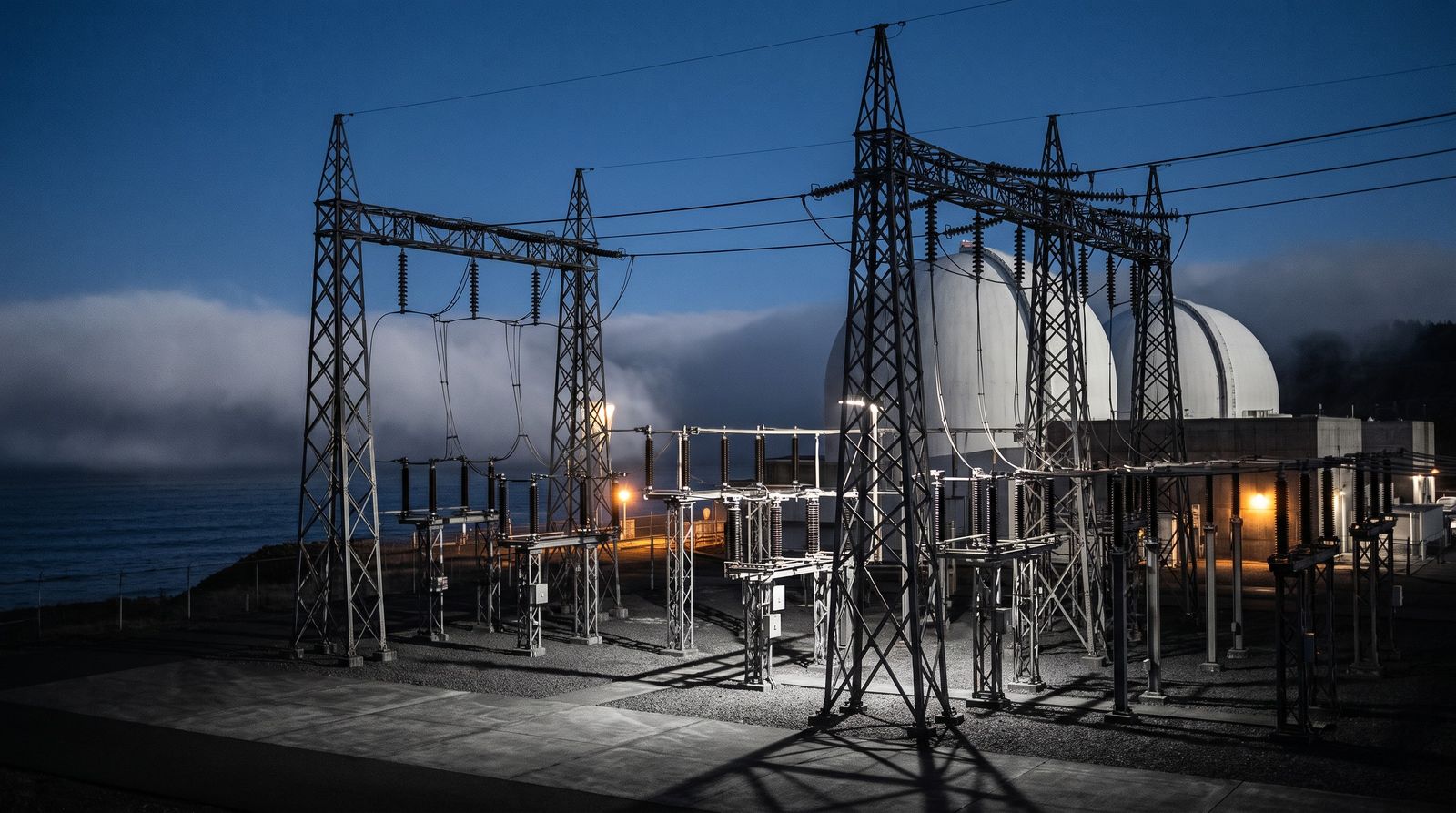
Oregon Nuclear owns the wires as well as the plant. From the 230 kV switchyard the South Coast Loop runs north to Langlois and Bandon and south to Port Orford and Gold Beach, with four substations, ten feeders and about 6,100 meters between them, and a line north to the state's interconnection at Coos Bay that carries the rest of what the units make.
The loop
From Bandon to Gold Beach
- 230 kV line
- Substation, 115/12.5 kV
- Switching station
- The Pacific
Substations and feeders
Who is on which line
| Substation | Feeders | Serves | Meters |
|---|---|---|---|
| Langlois | LG-1 · LG-2 | Langlois, Floras Lake, Sixes, Cape Blanco Road and the station's own services | 652 |
| Port Orford | PO-1 · PO-2 · PO-3 · PO-4 | Port Orford from Garrison Lake to Humbug Mountain, the harbor, the Elk River valley and the clinic | 2,248 |
| Bandon | BD-1 · BD-2 | Old Town Bandon, Beach Loop, the industrial park, the cranberry bogs and Coquille Road | 1,705 |
| Gold Beach | GB-1 · GB-2 | Gold Beach, Wedderburn, North Bank Road, Jerrys Flat Road, the airport and the county yard | 1,470 |
| Humbug | — | A switching station between Port Orford and Gold Beach; no customers | 0 |
Meters are the customers connected, not people. The station's own services ride a feeder of their own from Langlois, LG-2, with emergency diesels behind them.
Planned work
What the crews are doing
Planned outages are short, in daylight, and announced to the meters affected by card and by KGAJ a week ahead. The work below is by season; the day and hour come on the card.
| Season | Where | Work | Who notices |
|---|---|---|---|
| This autumn | Elk River Road (PO-4) | Tree trimming along the right-of-way | Brief interruptions, mid-morning, announced by card |
| This autumn | North Bank Road (GB-1) | Pole replacements found by the inspection cycle | Two short planned outages, daylight |
| Before the winter storms | Every yard | Spare transformers and storm stock in place; the storm roster posted | Nobody |
| This winter | Beach Loop, Bandon (BD-1) | Pole replacements and a new recloser | One planned outage, a weekday morning, announced by card |
| This spring | Port Orford substation | Breaker maintenance on feeders PO-2 and PO-3 | Load carried by the other feeders; nobody |
| This spring | Harbor and dock (PO-2) | Scheduled maintenance on the harbor block, on a work order with the port | Arranged with the dock master around the fleet |
| Early summer | Langlois yard | The new apprentice class starts; training field work | Nobody |
Report an outage
Lights out?
Restoration
How the lights come back
When a feeder trips in a storm the dispatcher sees it first, on the console at the station, and the recloser on the line tries three times in a few seconds to put the power back, which clears a branch that has brushed the wire. If the fault holds, the block it is in is isolated, the blocks around it are switched back on from the other direction where the loop allows, and a crew is sent. The crew finds the fault, makes the line safe, repairs it and calls the dispatcher, who closes the block on a work order and writes it in the log. Nothing on the loop is switched without a work order number and a reason, and the log keeps every line.
In a big storm the order of work is the one in the box above, and the outage line's recording is updated every hour with where the crews are. Estimates of restoration time are honest and usually a little pessimistic.
The plant behind the loop.
Two units, about 2,270 megawatts, and the switchyard where the loop begins.