
Neighbors
Community
1,140 people work at the station, and most of them live between Bandon and Gold Beach. The visitor center is open to everyone, the plant tour to anyone eighteen and over who books, and the Sixes River Fund gives a quarter of a million a year to the places we live.
Visit
The visitor center and tours
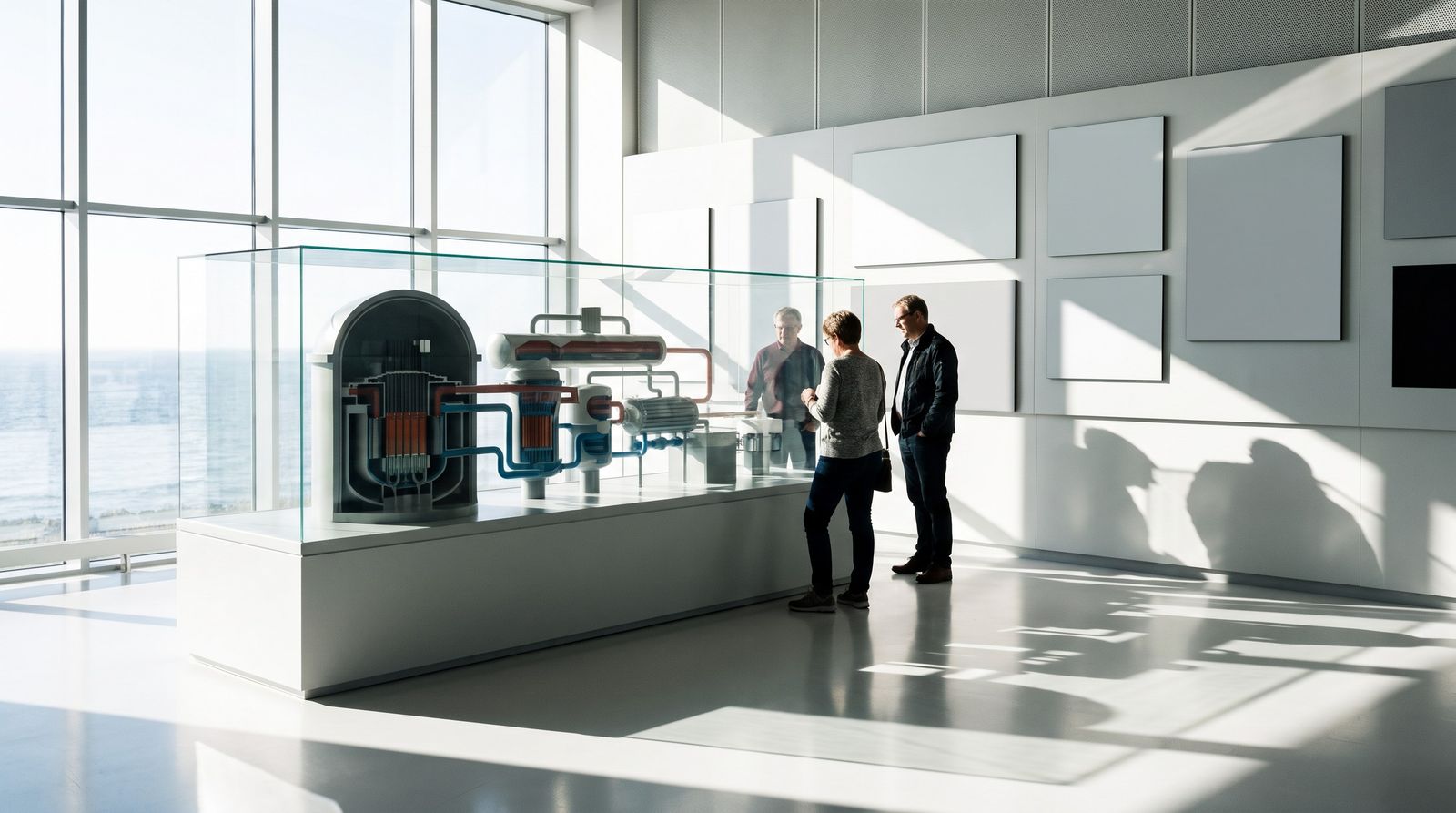
The visitor center stands on the bluff outside the fence, at the end of Sixes River Station Road, with the domes to the north and the estuary to the south. Inside is a model of the Unit 1 control room that runs a scripted shift, with alarms; a full-size mock-up of a fuel assembly you can stand beside; the estuary program's tanks and its counts on the wall; a cutaway of a dry cask; and a window onto the switchyard with the loop drawn beneath it. The staff are retired operators and the program's biologists. Admission is free, and so is the coffee. Binoculars for the estuary trail are at the desk.
Hours. Wednesday through Sunday, ten in the morning to four in the afternoon. Closed on the major holidays and during the two drill weeks of the year, which are posted at the door and on the recorded line.
Plant tours. A tour of the protected area, two hours on foot through the turbine hall, past the control room's observation gallery and out to the dry cask pad, runs on Thursdays and Saturdays by appointment. Tours are for visitors eighteen and over with government photo identification, in groups of no more than twenty, booked at least two weeks ahead so that the names can be cleared by security. Flat shoes, long trousers and no bags; the station lends hard hats and glasses. Cameras are not allowed inside the fence.
Book a tour or ask about the center on the tour desk line, (696) 412-0530, or write to visit@oregonnuclear.com.
Giving
The Sixes River Fund
The Sixes River Fund is the station's grant program for the South Coast: $250,000 a year to organizations between Bandon and Gold Beach, in grants from a few thousand to fifty thousand, decided by a committee of seven employees and seven neighbors who visit every applicant. The Fund has made grants every year for more than two decades, to fire districts and libraries, the harbor and the trails, the food pantries and the search and rescue team, the high school's teams and clubs, and the watershed councils of the Elk and the Sixes.
This year's eleven grants went from a compressor for the harbor's ice plant to a roof for the Langlois library. Applications open each spring; the committee asks for a page, not a binder, and answers by early summer. Ask for the form from the Communications & Community office, (696) 412-0540, or write to community@oregonnuclear.com.
Stay in touch
The newsletter, The Bluff
Learning
Schools
The station works with the South Coast's teachers, not around them. An energy unit for the middle grades, written with the district's science teachers, comes as a classroom kit with a working model turbine, a Geiger counter and a set of the rocks of this coast that click; the station lends the kits and a biologist or an operator comes to the classroom for the last lesson. Once a year the station hosts an energy day at the high school, with the model control room on a trailer, and each summer a teachers' institute spends three days inside the fence. The high school's robotics team is a Fund grantee, and the line apprenticeship takes two of its graduates most years.
School groups visit the visitor center by arrangement with their teacher. The plant tour itself is for adults. The station does not photograph school visits and does not publish pictures of children; what the programs do is described here in words, and the teachers who run them are the people to ask.
Here
The station in the community
With 1,140 employees the station is the largest employer on the South Coast and Curry County's largest taxpayer. Its people coach the teams, sit on the councils and the port commission, crew the fire district's engines and the search and rescue team, and fish the harbor on their days off. The Langlois fire station was rebuilt with the station's help and serves as the planning zone's shuttle stop and its reception point in a drill. When the harbor's cranes need power at three in the morning for a boat coming in heavy, the Grid Operations desk knows the dock master by name.
Questions about any of this go to the Communications & Community office: (696) 412-0540, community@oregonnuclear.com. .
Open house parking is at the visitor center and in the overflow lot on Sixes River Station Road, with a shuttle from the Langlois fire station through the day. Nothing was sent; this note is the whole answer.
Inside the planning zone?
The sirens, the broadcast partners and where to pick up potassium iodide tablets are on one page, and the planning guide reaches every household in the zone each year.